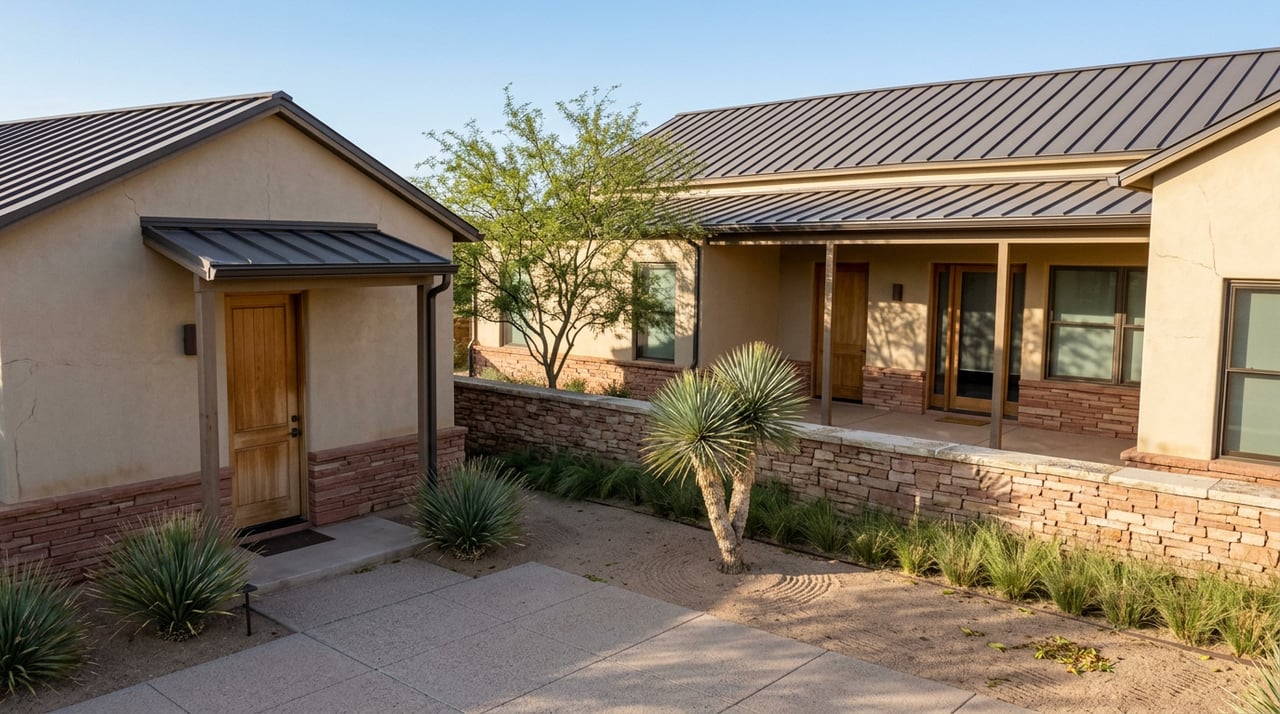
Say you're comparing a listing in Sedona against something similar in Cottonwood or Camp Verde, and the Sedona property has a detached casita along with the main house. The listing photos show two kitchens, two entrances, two sets of furniture staged for two separate Airbnb guests. The math looks obvious: one property, two income streams.
It isn't that simple anymore, and the reason has nothing to do with the home's condition or its price. It comes down to a single date stamped on a permit record most buyers never think to ask for before they write an offer.
The Permit Question That Comes Before the Offer
Since December 2024, Sedona has required a separate short-term rental permit for every unit advertised on a parcel. A main house and a casita rented as two listings need two permits, each carrying its own $210 annual fee. That part is straightforward paperwork.
The harder question is whether the casita is even eligible to be its own listing in the first place. When the city's short-term rental specialist, Teresah Arthur, audited properties advertising multiple units on a single lot, she identified 97 properties doing that, fewer than the roughly 300 she expected going in. That audit wasn't a one-time sweep. Arthur told the city council she planned to make it a recurring check, twice a year, specifically to catch anyone who quietly opens up a second unit without going through the process.
The Date That Decides Everything
Here's the mechanism that actually controls whether that casita can be rented as a stand-alone unit: the certificate of occupancy date.
In September 2024, Sedona amended its code so that any accessory dwelling unit issued a certificate of occupancy on or after September 14, 2024 cannot be used as a short-term rental unless the owner's primary residence is the main structure on the same parcel. In plain terms, if you buy the property and don't live in the main house full time, a newer casita can't legally be its own listing at all. It can only function as owner housing, a long-term rental, or space for guests who aren't paying by the night.
Guest quarters that received their certificate of occupancy before that date are treated differently. The city council's final language, approved as a consent item on March 25, 2025, grandfathers those older structures as a legal nonconforming use. They can be rented as short-term units regardless of whether the owner lives on site, as long as nobody converted the kitchenette into a full kitchen or modified the structure without a permit along the way.
| Structure type | Certificate of occupancy | Can it be a stand-alone STR? |
|---|---|---|
| Guest quarters | Before Sept. 14, 2024, unmodified | Yes, regardless of owner occupancy |
| Guest quarters | Before Sept. 14, 2024, kitchen upgraded or unpermitted changes | No, treated as new ADU rules |
| Accessory dwelling unit | On or after Sept. 14, 2024 | Only if owner lives in main house |
That grandfathered status travels with the structure, not the seller. If you buy a home with a pre-2024 guest quarters that's still in its original condition, you inherit that eligibility. What you don't inherit is the STR permit itself. Permits are non-transferable and tied to the individual owner, so a new buyer has to apply for their own after closing, even on a unit that's been renting successfully for years.
This is the specific thing to confirm before you're under contract, not after. Ask for the certificate of occupancy date on any casita or guest house before you write an offer that assumes two income units. It's a record the city already has, and a seller or listing agent should be able to produce it.
The State Fix That Didn't Happen
For a while, it looked like the ADU rule might get overtaken by something bigger. House Bill 2429, sponsored by Rep. Selina Bliss, would have let Arizona cities set occupancy formulas and, in earlier drafts, cap the total number of STR permits issued. The bill passed the Arizona House in March 2026 on a final vote of 37-14, then went to the Senate.
That's where it stalled. It never got a hearing in either committee it was assigned to, and by late April 2026, Bliss told the Sedona Red Rock News the bill was likely dead for the session.
"I pushed to the very end, I did everything strategically possible given the timeframe, and that's how it ended."
By early May, she told the Arizona Capitol Times she was already thinking about how to bring the bill back next year. For now, the state-level preemption under SB 1350 still stands: Sedona cannot cap the number of STR permits it issues or ban short-term rentals outright. That means the September 2024 ADU rule isn't a stopgap waiting to be replaced by something broader. It's likely to remain the single most consequential local restriction on Sedona's STR supply for at least another year, maybe longer if the bill keeps stalling in future sessions.
The Math Is Already Tightening Without Any New Rule
Even for a unit that clears every permit and occupancy hurdle, the returns picture has shifted in a way that's easy to miss if your reference point is a few years old.
Sedona's active STR listings grew from 1,113 in 2021 to roughly 1,805 as of February 2026, a 62 percent increase. Over that same stretch, occupancy fell from 68 percent to 53 percent. Average daily rate climbed from $353 to $440, which has cushioned some of that decline, but the net effect is a market with more competing listings chasing a shrinking share of booked nights.
Against a typical Sedona home value near $888,800, a median-performing listing brings in about $54,852 a year in gross revenue, with operating expenses typically eating 25 to 35 percent of that. At that revenue level, average operators land just below the 1.0 debt service coverage threshold many lenders use to qualify a rental property. Top-quartile performers, the listings hitting 72 percent occupancy or higher and commanding rates north of $546 a night, clear that threshold with room to spare. The gap between an average Sedona STR and a top-quartile one isn't cosmetic. It's the difference between a property that qualifies for financing on its own income and one that doesn't.
What This Means If You're Underwriting a Purchase
None of this makes Sedona a bad rental market. It makes it a market where the paperwork and the performance data both need to check out before the purchase, not after.
Before you make an offer on a property marketed with a guest house or casita income component, confirm:
- The certificate of occupancy date on the accessory structure
- Whether the current STR permit (if any) will need to be reapplied for under your name after closing
- Whether the property's trailing revenue and occupancy numbers reflect top-quartile performance or something closer to the market median
- The applicable combined tax rate, which runs 13.325 percent in the Yavapai County portion of Sedona and 13.9 percent in the Coconino County portion, since the city straddles both
A property that pencils out as a strong STR play on paper elsewhere in the Verde Valley may not pencil out the same way inside Sedona city limits, where this specific ADU restriction, the per-unit permit rule, and the twice-yearly compliance audit all apply.
A Few Questions Worth Settling Before You Offer
Does the September 2024 rule apply if I buy a home that already has a legal guest house? It depends on the certificate of occupancy date, not who owns the property. If the structure was completed before September 14, 2024 and hasn't had unpermitted changes or a kitchen upgrade, it keeps its grandfathered status when it sells. The STR permit itself still doesn't transfer, so you'll need to apply for your own after closing.
Could Sedona still end up with a cap on STR permits? Not under current law. State preemption blocks it. HB 2429 would have opened that door, but it stalled in the Senate in 2026 and its sponsor is already planning a revised bill for next session, so this is worth watching rather than assuming settled.
How do I actually confirm a guest house's certificate of occupancy date before I offer? Ask the seller or their agent directly. It's a document the city maintains, and requesting it alongside standard seller disclosures costs you nothing but a conversation.
If you're weighing a Sedona property against options elsewhere in the Verde Valley, or trying to figure out what a specific casita or guest house can legally earn before you write an offer, Sylvia Ray has spent decades tracking exactly this kind of local detail. Request a market consultation before you're under contract, not after.